News
The Canadian Cancer Society funds three projects involving four IRIC researchers
Published on September 3, 2026
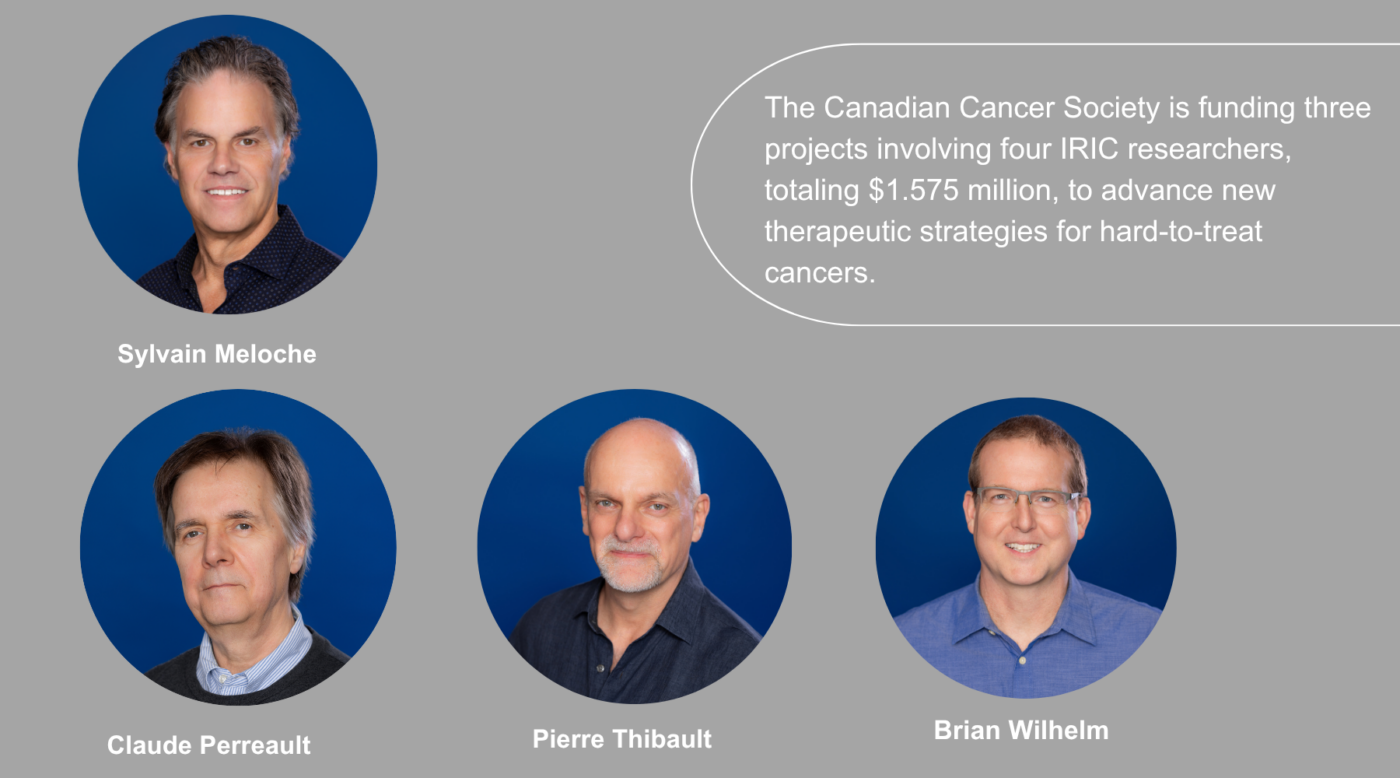
The Canadian Cancer Society (CCS) is awarding three grants totaling $1,575,000 to projects involving four IRIC researchers: Sylvain Meloche, Claude Perreault, Pierre Thibault, and Brian Wilhelm. Each grant, worth $525,000, will support the teams from 2026 to 2029 in developing new therapeutic strategies against hard-to-treat cancers.
A New Treatment for Aggressive Nerve Tumors
Neurofibromatosis type 1 is a genetic disorder that can lead to the development of malignant peripheral nerve sheath tumors (MPNSTs). Surgery is currently the primary treatment, but the location of these tumors can make complete removal difficult. No other effective treatment options are currently available, and the survival rate remains low.
The laboratory of Sylvain Meloche, director of the IRIC’s Signalling and Cell Growth Research Unit, has discovered that the YES and SRC proteins contribute to the growth and survival of MPNST cells. The team has therefore designed a molecule capable of inhibiting these two proteins and will now evaluate its efficacy, either alone or in combination with other treatments. If the preclinical results are conclusive, this strategy could eventually be evaluated in clinical trials and offer a new treatment option for people with this difficult-to-treat cancer. This grant is funded by the CCS in partnership with the University Health Network (UHN).
“This funding is essential to moving our project forward. Despite progress made in treating many types of cancer, there is no effective treatment for malignant peripheral nerve sheath tumors (MPNSTs), and survival rates are low. My research team has identified a promising new treatment that requires further validation before it can be tested in humans. The generous funding from the CCS, in partnership with the University Health Network, will allow us to refine our strategy, move it closer to the clinic, and offer hope to people with MPNSTs.” — Sylvain Meloche
Making Breast Cancers More Sensitive to Immunotherapy
Estrogen receptor-positive (ER+) breast cancer is the most common type of breast cancer. Its cells use estrogen as a growth signal and generally respond poorly to immunotherapy, even though this treatment shows promise against many cancers. This is because they display few antigens on their surface, making them harder for the immune system to recognize.
Claude Perreault, director of the Immunobiology Research Unit at IRIC, Pierre Thibault, director of IRIC’s Proteomics and Mass Spectrometry Research Unit, and their colleagues recently discovered that cyclin-dependent kinase 4 and 6 (CDK4/6) inhibitors can cause ER+ cancer cells to present more antigens that are recognizable by the immune system.
The teams will now seek to determine which antigens are specific to ER+ cancer cells. This research could lead to the development of therapeutic vaccines or other targeted treatments that make these cancers more vulnerable to immunotherapy while limiting adverse effects.
“Funding from the CCS allows us to explore a truly innovative project that will have a major impact on the treatment of the most common type of refractory breast cancer.” — Claude Perreault and Pierre Thibault
Understanding Treatment Resistance in Pediatric Leukemia
Acute myeloid leukemia (AML) is a cancer of the blood and bone marrow that can affect children, among other populations. Most children initially respond to treatment, but the disease recurs in more than one-third of cases. It then often becomes resistant to treatment, which significantly reduces the chances of survival.
Kristin Hope, of the Princess Margaret Cancer Centre, and Brian Wilhelm, director of the High-Throughput Genomics Research Unit at IRIC, are seeking to understand how leukemia cells regulate proteins that promote cancer progression and resistance to treatment. The results of this study could lead to the development of drugs that directly target the identified resistance mechanisms in order to improve the long-term effectiveness of treatments against AML relapse in children.
“This funding will allow us to use state-of-the-art methods and leverage the unique, complementary expertise of our teams to understand how resistance to leukemia treatments arises and to develop strategies to overcome it. With the knowledge gained from this research project, we aim to find new ways to ensure long-term treatment effectiveness for many more children with acute myeloid leukemia (AML).” — Brian Wilhelm
Congratulations to the teams of Sylvain Meloche, Claude Perreault, Pierre Thibault, and Brian Wilhelm on receiving this funding!