News
The Cancer Research Society Supports Three Research Projects at IRIC to Explore New Therapeutic Approaches
Published on November 17, 2026
The Cancer Research Society Supports Three Research Projects at IRIC
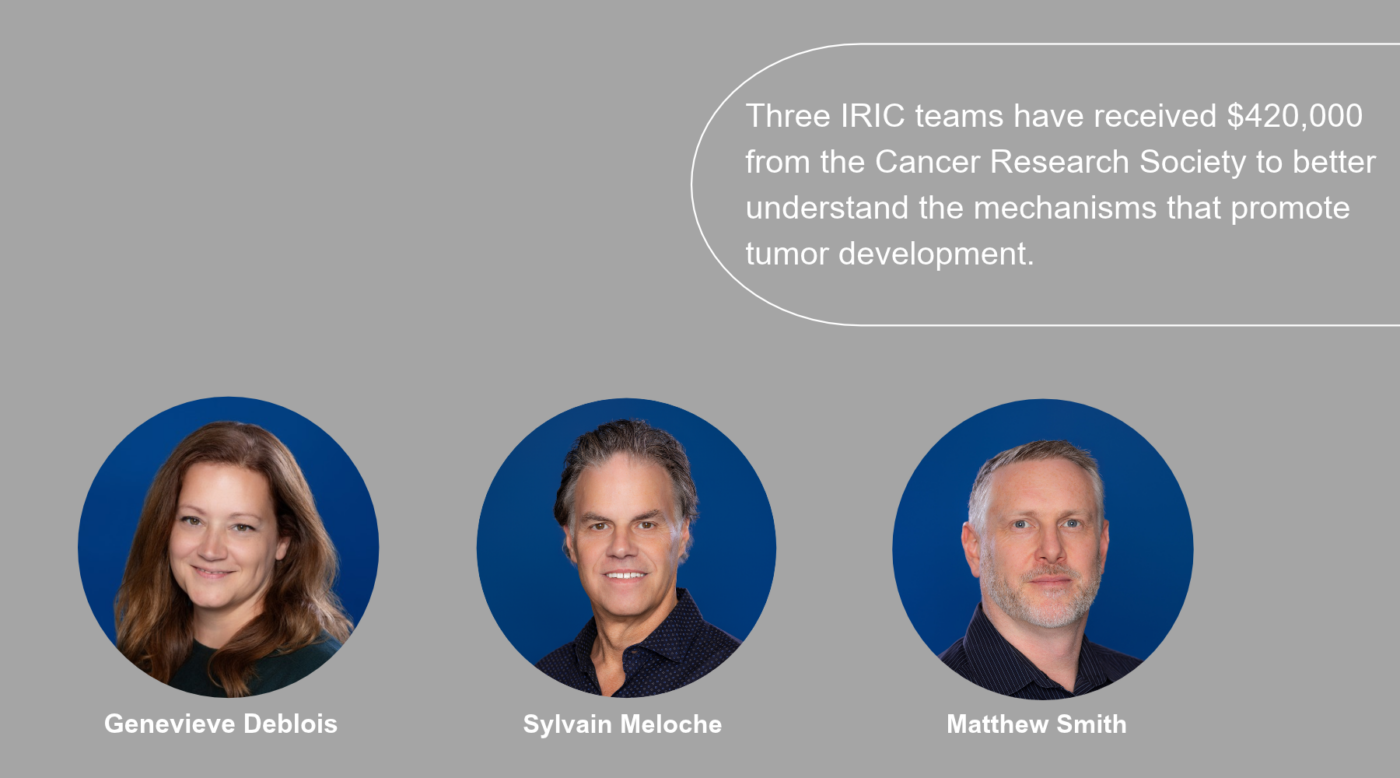
The Cancer Research Society (CRS) has awarded three operating grants to the teams led by Geneviève Deblois, Sylvain Meloche, and Matthew J. Smith. Worth $140,000 each over two years, these grants total $420,000 and will support research on triple-negative breast cancer, pancreatic cancer, and the mechanisms that regulate cancer cell proliferation.
Exploring a New Target in Triple-Negative Breast Cancer
Triple-negative breast cancer is an aggressive form of breast cancer for which treatment options remain limited. A better understanding of the mechanisms that promote tumour cell growth could help identify new therapeutic targets.
Geneviève Deblois, who directs IRIC’s Epigenetic Mechanisms and Cancer Metabolism Research Unit, and her team are studying BRD1, a protein that recognizes certain marks on chromatin, the structure in which DNA is organized. Their preliminary results show that inhibiting BRD1 markedly reduces tumour cell growth. The team will investigate the underlying mechanism. Since BRD1 can already be targeted with pharmacological compounds, this research could pave the way for new therapeutic approaches.
“This funding from the CRS gives us the opportunity to explore in depth a new and promising line of research for the treatment of aggressive breast cancers.” — Geneviève Deblois
Targeting YES and SRC Kinases in Pancreatic Cancer
Pancreatic ductal adenocarcinoma is often diagnosed at an advanced stage because it causes few symptoms in its early stages. At that point, treatment options are limited.
The team led by Sylvain Meloche, director of IRIC’s Cell Signalling and Growth Research Unit, has discovered that two enzymes, the YES and SRC kinases, play a role in the growth of these tumours. The team has also helped develop a compound that blocks their activity and has slowed tumour growth in preclinical models. With this grant, the team will evaluate the compound’s effectiveness, alone or in combination with RAS inhibitors, in cell and animal models.
“We are studying a signalling pathway that contributes to the survival of pancreatic cancer cells. By targeting it, we hope to pave the way for a new therapeutic approach that could be used alone or in combination with RAS inhibitors.” — Sylvain Meloche
Understanding How to Reactivate the Brakes on Cancer Cell Proliferation
RAS proteins are best known for stimulating cell proliferation. They can also engage mechanisms that restrain it, including the Hippo pathway, a protective mechanism that is often weakened in RAS-associated cancers.
Matthew J. Smith, director of IRIC’s Cell Signalling and Structural Biology Research Unit, and his team are seeking to understand how RASSF proteins activate the Hippo pathway. Their initial findings suggest that membranes and microtubules, components of the cytoskeleton, serve as meeting points for the proteins that activate these brakes. The project combines the team’s expertise in RAS biochemistry with Susanne Bechstedt’s expertise in microtubules at McGill University and Vincent Archambault’s expertise in cell division and live-cell imaging at IRIC.
“Our work aims to understand how this balance is controlled and how strengthening these brakes could open up new therapeutic avenues.” — Matthew J. Smith
Congratulations to all three teams on receiving these grants!